Botanary: One Authorization. Every Chain. Enforced.
Framing: Product explanation - what it does, how it works, why it's safe
Framing: Product explanation - what it does, how it works, why it's safe
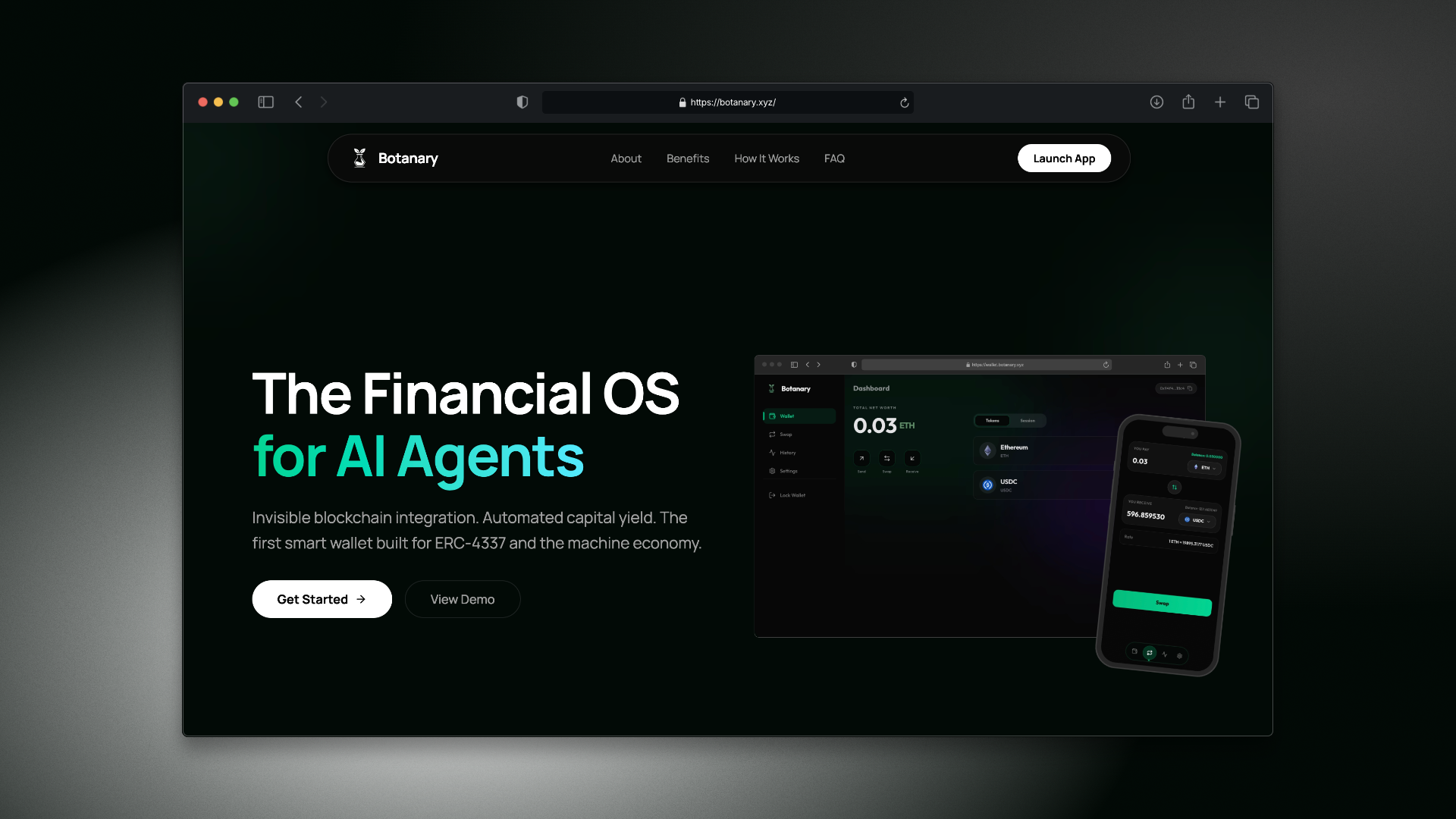
Botanary is a financial operating system for AI agents. It lets businesses and developers define exactly what a given AI agent is authorized to do financially - which assets, which protocols, what value limits, for how long - and enforces those constraints natively on every blockchain the agent operates across.
The enforcement is not application-layer. It is VM-layer. On EVM chains, the policy lives in the agent's smart account authorization module. On Move chains (Sui and Aptos), it lives in capability objects and permissioned signers enforced by the language's type system. The agent cannot exceed its authority because the blockchains themselves reject the attempt - not because any software running between the agent and the chain said no.
One mandate, every chain
The authorization flow is designed around how humans actually think about delegation, not around how blockchains technically implement it.
A business that wants to authorize an AI agent to handle vendor payments sets one policy: the agent can spend up to a defined amount per day in USDC, it can interact with specific payment protocols, each transaction is capped at a defined value, and the authorization expires at a defined time. That's the human decision. It's expressed once, in plain terms.
Botanary's authority layer compiles that mandate into the chain-specific authorization primitives required by each network the agent will operate on. The human approves once. The enforcement is established across all relevant chains simultaneously.
Revocation works the same way: one action from the authorizing account, and the agent's authority is withdrawn across all chains. The agent holds no keys that survive revocation. There is no "wait for the session to expire" - the cancellation is immediate and definitive.
Payments that route themselves
Botanary's payment layer is designed around a practical reality of operating across multiple blockchains: the best stablecoin to hold is not always the best one to pay with, and the best chain to hold funds on is not always the cheapest one to transact on.
An agent authorized to make payments doesn't need to manage this complexity. When the agent initiates a payment, Botanary's routing layer finds the best path from the agent's current holdings to the payee's preferred settlement - bridging, swapping, and routing across chains and stablecoin standards automatically. The agent sees a payment instruction and a confirmation. The routing is invisible.
The routing applies strict rules: every transfer is atomic. If any step fails - a bridge transaction, a swap, a network congestion spike - the entire operation reverts. Funds are never left stranded in an intermediate state.
The agent never needs a gas token
One of the most friction-generating requirements for multi-chain agent operation is native gas. Every chain has its own gas token: ETH on Ethereum, SOL on Solana, APT on Aptos, SUI on Sui. An agent that operates across four chains needs funded gas accounts on four chains, managed and topped up continuously.
Botanary's gas abstraction eliminates this requirement. Agents pay for all transaction costs in the stablecoin they already hold. The infrastructure handles gas sourcing transparently. Deploying an agent across new chains doesn't require a new gas management workflow.
What agents can do on Botanary
An AI agent with a Botanary treasury account can:
Pay for APIs, compute, and services automatically using x402-compatible payment protocols - no accounts, no credit cards, no manual billing management. Pay per call, as calls are made.
Hold working capital in stablecoins across any supported chain without managing individual chain balances. The unified balance layer presents one balance; funds are materialized at the destination chain when needed.
Operate within a spending policy that the human set and only the human can modify. Every action is logged on-chain. The audit trail is permanent and independent of any application database.
Accept payments in any stablecoin from any supported chain and receive settlement in the stablecoin the agent uses for operations - without handling the conversion manually.
Designed for the SEA market
Botanary's initial market focus is Southeast Asian small and medium businesses: a region with deep mobile-first payment culture, high stablecoin adoption driven by remittance use cases, and growing interest in AI automation.
USDT on Tron is the dominant payment rail in this region - high volume, low cost, and deeply integrated into the local payment ecosystem. Botanary treats this as a first-class rail, not an afterthought. The routing layer supports Tron USDT natively alongside USDC on EVM and Solana chains.
Botanary is currently in development. Early access for SEA businesses and developers is available at botanary.xyz.
Read the latest
Related dispatches
Oyrade: Prediction Markets Where Your Position Is Your Business
Framing: Product explanation
Jul 2, 2026
Tasmil Finance: AI Yield Optimization That Proves Its Work
Framing: Thought leadership + live product
Jul 2, 2026
The Hidden Cost of AI Models That Don't Know Where Their Data Came From
Framing: Thought leadership - establishes the problem Capydata solves
Jul 2, 2026