The Hidden Cost of AI Models That Don't Know Where Their Data Came From
Framing: Thought leadership - establishes the problem Capydata solves
Framing: Thought leadership - establishes the problem Capydata solves
When an AI model answers a question, it draws on patterns learned during training. If those patterns came from high-quality, accurately labeled data, the model tends to perform well on similar questions. If the data was low quality, mislabeled, or systematically biased toward certain patterns, the model reflects those flaws - often without any signal to the user that something is off.
The problem is that data provenance - where training data came from, how it was collected, how it was labeled, and what its known limitations are - is largely invisible in most AI deployments. Models are trained, deployed, and queried without any mechanism for downstream users to verify the quality of what the model learned from.
For general-purpose applications, this is a frustration. For high-stakes applications - financial analysis, medical information, legal research - it is a structural problem.
Data as a commodity versus data as a verified resource
Most AI data flows today work like a commodity market where all products look identical: data is scraped, aggregated, cleaned, and sold without the buyer having meaningful visibility into the provenance chain. Did the training data for this financial model include survivorship-biased historical records? Was the labeling done by qualified domain experts or by crowdsourced annotators with no relevant background? Were there known data quality issues in the collection process?
These questions don't have easy answers in the current ecosystem, because there is no standard mechanism for data providers to attest to quality properties or for buyers to verify those attestations independently.
The market that should exist
A functioning data market would work differently. Data providers would publish datasets with verifiable attestations about how they were collected, how they were labeled, and what their known limitations are. Third-party verifiers would audit those attestations and stake reputation on their accuracy. Buyers would pay per access, not per bulk license, making it economically practical to purchase specialized, high-quality data for specific use cases.
The critical properties: payment settlement would be automatic, tied to access, without requiring account relationships or bulk licensing contracts. Provenance attestations would be on-chain, persistent, and independently verifiable. Access control would be enforced by the protocol, not by an API key that can be copied and shared.
This is the infrastructure gap that Capydata addresses.
How Capydata works
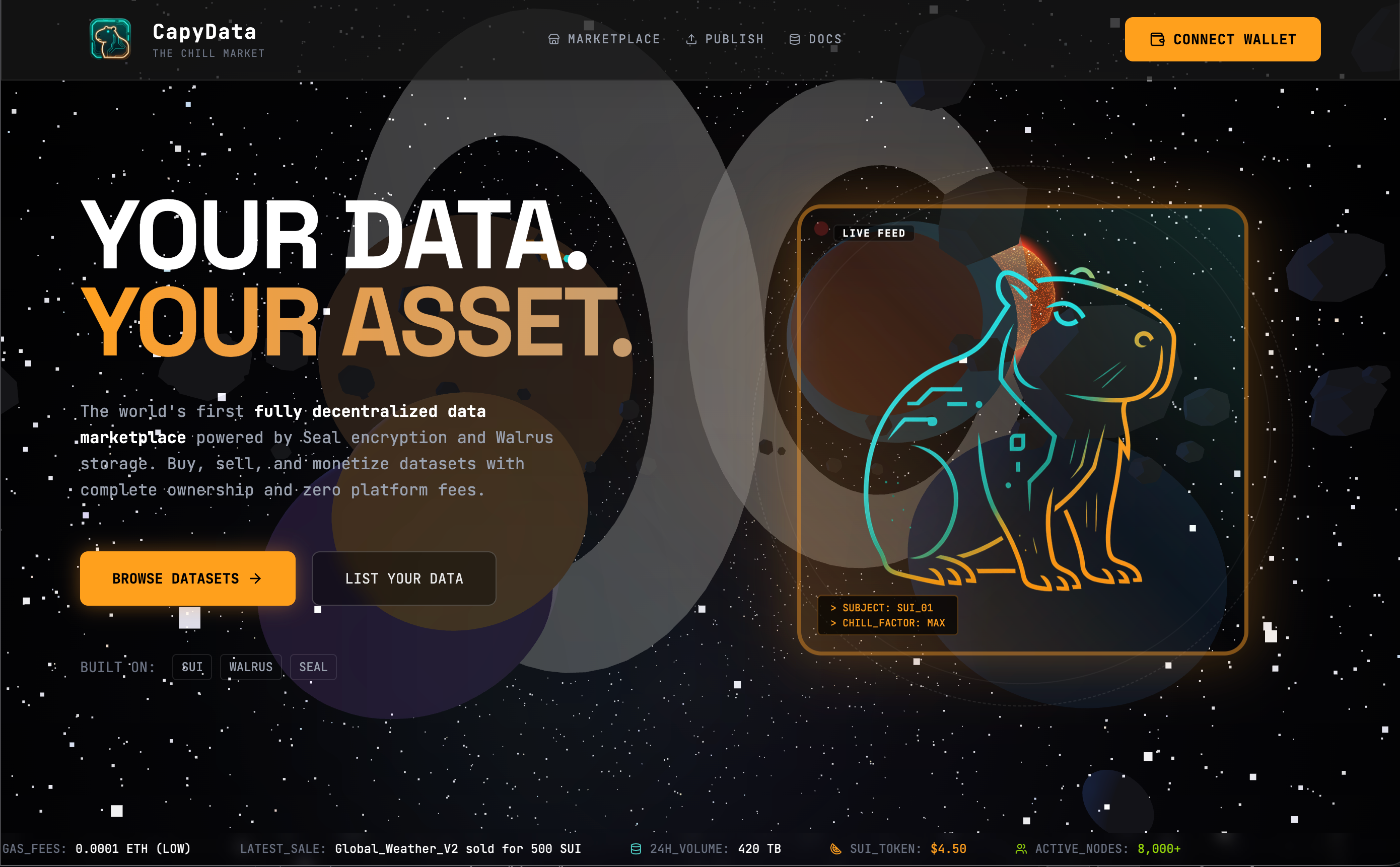
Capydata is a decentralized data marketplace built on Sui. Every dataset is represented as an on-chain object with its metadata, access control rules, and provenance attestations attached.
Data providers publish their datasets with staked attestations: the attestation record specifies properties of the dataset (size, collection methodology, labeling process, known limitations) and is backed by stake that the provider loses if the attestation is found to be inaccurate. Third-party auditors can add their own attestations, also staked, creating a layered provenance record that buyers can evaluate before purchasing access.
Buyers purchase access using per-query payments compatible with the x402 payment standard. An AI agent that needs specialized data can pay per call, automatically, without managing subscriptions or API credentials. The access rights are enforced by the on-chain capability object - not by any centralized service. Access expires when the terms dictate.
Why Sui
Sui's object model maps directly to dataset access control. Each dataset is a Sui object. The capability object a buyer receives after payment defines exactly what they can do: how many queries, through which interfaces, until when. The Move type system enforces these constraints at the VM level. A buyer cannot query beyond their authorized access - the protocol rejects the attempt.
For data providers, this means their access control is enforced without running any infrastructure of their own. The blockchain is the access control layer.
The provenance chain that AI needs
As AI systems take on higher-stakes tasks, the traceability of their inputs becomes more important - not just for quality assurance, but for accountability. A financial AI system that can point to a verifiable provenance chain for its training data and inference-time data sources is a more credible system than one that cannot.
Capydata is building the infrastructure that makes that traceability possible: a marketplace where data quality is staked on-chain, where access is controlled by protocol rather than by trust, and where the provenance record follows the data from provider to consumer.
Capydata is in development. Developer access is available at capydata.xyz.
Read the latest
Related dispatches
Why We Believe the Next Frontier in AI Finance Is Verifiable Reasoning
Framing: Thought leadership - positions Morca Labs as serious R&D lab
Jul 2, 2026
Why AI Agents Need a Financial Operating System
Framing: Thought leadership - establishes the problem space Botanary solves
Jul 2, 2026
Oyrade: Prediction Markets Where Your Position Is Your Business
Framing: Product explanation
Jul 2, 2026