Research · 13 October 2026 · 7 min read
The primitive clock
By James Warder
- Framework
- x402
- ERC-8004
Why small teams arrive late
Most small teams pick what to build the way we used to: by how exciting it feels. Excitement peaks at stage 3, when the numbers are big, the funds are writing threads and every conference has a panel. By then the primitive belongs to someone else. You can still build on it. You cannot own it.
So we stopped asking "is this exciting?" and started asking "what time is it on the clock?"
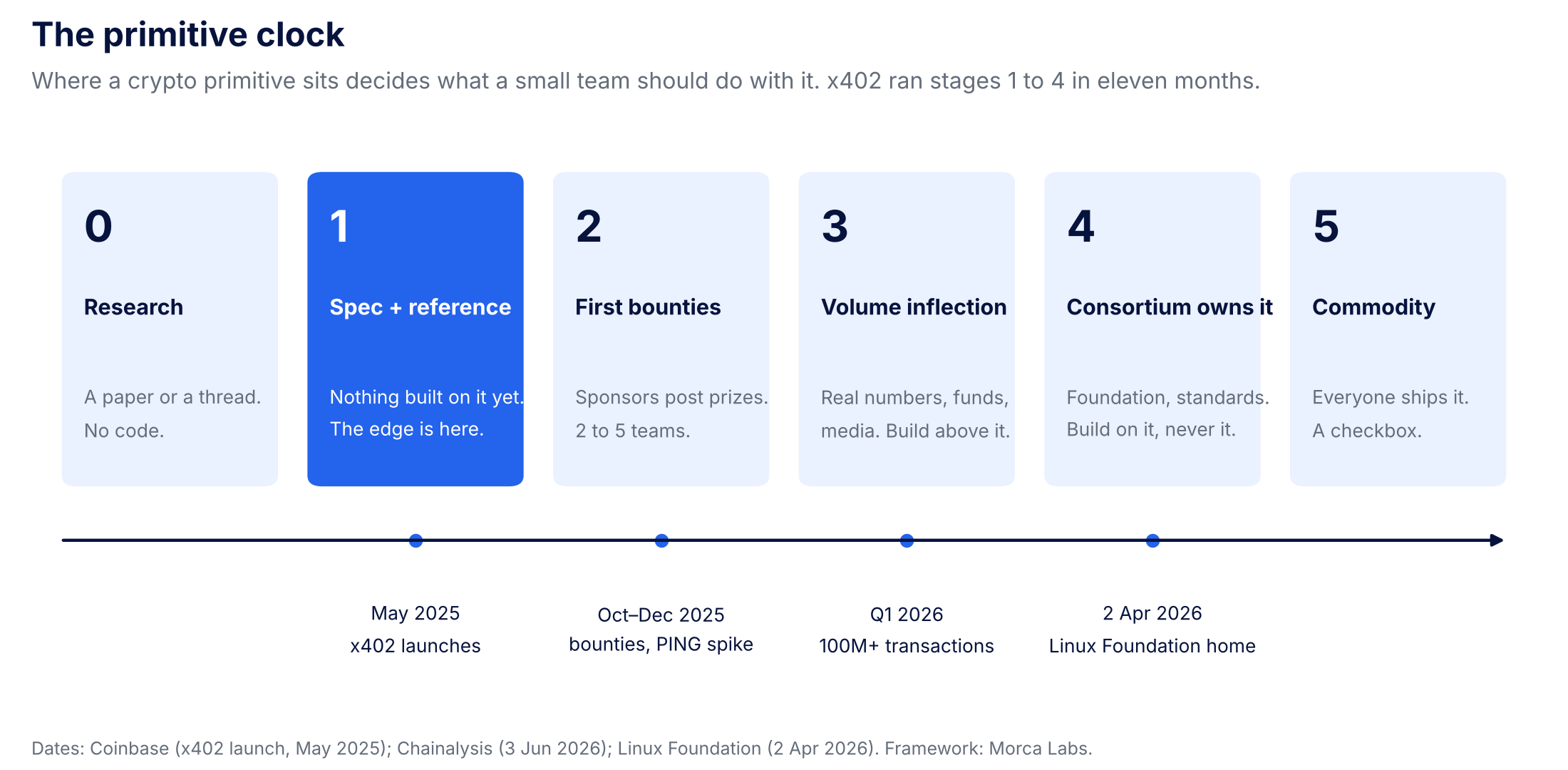
| Stage | What you can see | What a small team should do |
|---|---|---|
| 0 · Research | A paper or a thread. No code | Watch. Do not build |
| 1 · Spec and reference code | A draft standard or a library. Nothing built on it yet | This is the target. The edge lives here |
| 2 · First bounties | Sponsors post prizes. Two to five teams build | Move fast. The window is closing |
| 3 · Volume inflection | Real numbers, funds, media | Too late to own the primitive. Build the layer above it |
| 4 · Consortium owns it | A foundation, a standards body, the incumbents | Build on it. Never build it |
| 5 · Commodity | Everyone ships it | A checkbox |
How fast the clock runs: x402
x402 is the cleanest recent case because it is well documented.
- May 2025, stage 1. Coinbase publishes x402, a way to pay for an HTTP request with a stablecoin. There is a spec and reference code, and almost nothing built on it.
- Late 2025, stages 2 and 3. Sponsors put prizes on it. In the fourth quarter, transactions on Base jump more than 10,000% in one week, driven largely by a meme coin called PING (Chainalysis).
- Q1 2026, stage 3. Cumulative transactions pass 100 million (Chainalysis).
- 2 April 2026, stage 4. The Linux Foundation launches the x402 Foundation. Adyen, AWS, American Express, Circle, Google, Mastercard, Microsoft, Shopify, Stripe and Visa are among those listed in support (Linux Foundation).
Eleven months from a spec to a consortium. A team that noticed x402 at stage 3 had, at most, a quarter before the people who own payment networks owned the standard. That is not a reason to avoid x402. It is a reason to build the thing x402 does not do, rather than another x402.
What stage 3 looks like from the inside: ERC-8004
ERC-8004 gives AI agents an on-chain identity and a place to collect reputation. By mid-2026 its registration counts looked like adoption. Researchers from Imperial College London and others then measured what was behind them, using data up to 13 May 2026 (Xiong et al.):
- Only 3% (Ethereum), 4% (BSC) and 15% (Base) of registrations expose a valid registration file with at least one live service.
- 73.5%, 59.2% and 90.6% of reviewers on those chains show coordinated Sybil behaviour.
- The authors conclude that reputation "can be manipulated at minimal cost."
This is what stage 3 often looks like: a big count, mostly placeholders, plus a reputation layer that is cheap to farm. The opportunity there is not another registry. It is reputation that cannot be farmed. A record of what an agent was allowed to do and actually did is much harder to fake than a record of what it claims to be.
The other half: reading the numbers
The clock only works if you can read a stage honestly, and the numbers that define stages 2 and 3 are the easiest to buy.
Simon Brown scraped 8,200 projects from 38 ETHGlobal events and asked which categories actually win prizes (Simon Brown, 12 June 2026).
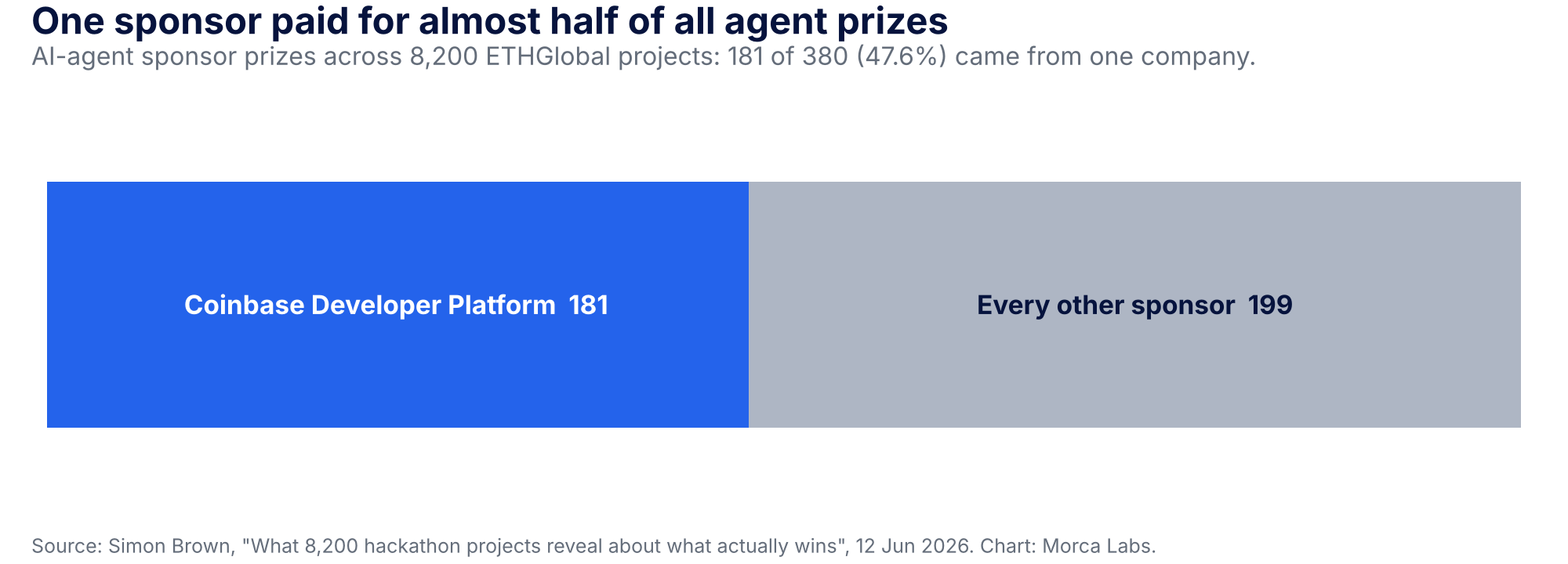
- Coinbase Developer Platform paid for 181 of 380 agent prizes, or 47.6%. The "agents win hackathons" trend was, to a large degree, one company's developer marketing budget.
- AI agents won more often than average (1.19×), but almost entirely inside events themed around agents. At ETHOnline 2025 agents won at 0.54×, and at New Delhi at 0.43×.
- Cross-chain atomic swaps were the worst bet in the dataset, at 0.63×. A large themed bounty attracted hundreds of near-identical clones.
None of this makes Coinbase wrong to sponsor agents. It means a sponsor-heavy prize table measures what sponsors want, which is a different thing from what users need.
Seven questions for any number
Before a number goes into anything we publish, it has to survive these:
- Whose money is behind it? Sponsor prizes, grants and incentives are marketing, not demand.
- Is it a count or a value? Counts are cheap to inflate. In x402's first year, removing wash and test activity cut 39% of transactions but 89% of dollars (Visa and Artemis).
- What is the average size? Fourteen cents per payment is API traffic, not commerce.
- How many unique participants? A million transactions from forty wallets is forty users.
- Is it incentive-driven? Points, airdrops and testnet rewards inflate everything. Say by how much.
- One chain or many? Organic activity spreads. Manufactured activity clusters where the incentive is.
- Who benefits if it is big? Then find a source who does not.
Then we file it under one of four labels: Organic, Incentive-driven, Sponsor-manufactured or Unverifiable. Only the first goes into a claim without a caveat.
What it caught for us
This is not a framework we built for other people. The first thing it caught was ourselves.
In July 2026 our own notes said nobody was shipping contract-enforced limits for AI agents. Checking that line against the market took less than a day. MetaMask had audited caveat enforcers. Zodiac Roles V2 had per-parameter scoping on mainnet. Coinbase and MetaMask had shipped agent wallets with limits. The claim was false, so we retired it the same week. It is the reason we now lead with the refusal record and not with the limit (see The limit is a commodity).
What would change our mind
- If teams that start building on a primitive at stage 3 or later build durable businesses on it as often as stage-1 teams do, the clock is noise.
- If stage durations stop compressing, and x402's eleven months turns out to be an outlier rather than the new normal, a small team has more time than this post suggests.
Disclosure: Morca Labs builds Gol. Gol sits in a category, agent authority, that is itself somewhere between stage 3 and stage 4 by this framework. That is one reason we compete on the record rather than on the limit.
Sources
- Chainalysis, Inside x402, 3 June 2026
- Linux Foundation, x402 Foundation launch, 2 April 2026
- Visa and Artemis, Agentic Payments from the Ground Up
- Xiong et al., Can Trustless Agents Be Trusted? (2026)
- Simon Brown, What 8,200 hackathon projects reveal about what actually wins, 12 June 2026