Research · 13 October 2026 · 7 min read
The limit is a commodity. The record is not.
By James Warder
- Agent authority
- Spending limits
- Competitive landscape
A message in Morse code
On 4 May 2026 a user on X sent Grok a message written in Morse code and asked it to translate it and pass it along to Bankrbot, a trading bot that acts on posts. The decoded text was a transfer instruction. Bankrbot sent 3 billion DRB tokens to the wallet named in it, worth $150,000 to $200,000 depending on whose valuation you use. (AI Incident Database #1556)
No contract was exploited. No key was stolen. An agent read a message and did what it said.
That is the failure that matters for agents with money. They do not need to be hacked. They need to be persuaded. And any system that reads untrusted text can be persuaded eventually. So the useful question is not "how do we make the agent wiser". It is "what happens on the day it is wrong".
The obvious answer is a spending limit. The real question is where that limit lives.
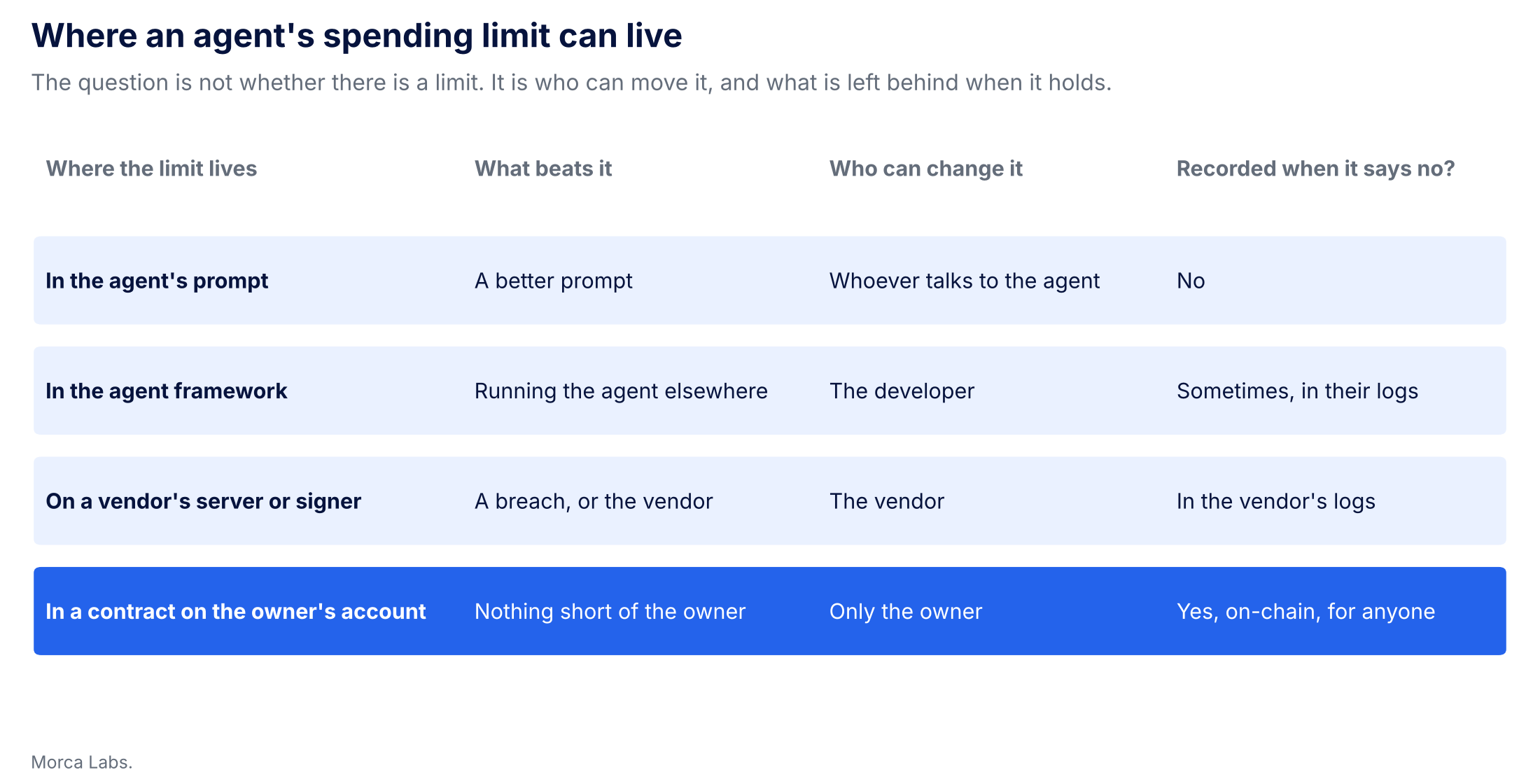
A limit written into the prompt is a request. A limit in the agent framework holds until the agent runs somewhere else. A limit on a vendor's server holds until the server is breached, or until the vendor changes it. A limit in a contract on the owner's own account holds even when every server involved is off, and only the owner can change it.
2026: the year limits became a feature
Twelve months ago "spending limits for AI agents" was a pitch. Now it is a checkbox on most agent wallets.
| Product | Shipped | What it limits | Where the check runs |
|---|---|---|---|
| Coinbase Agentic Wallets | 11 Feb 2026 | Per-transaction limits and session caps | Coinbase's policy engine, server-side, before an AWS Nitro enclave signs (Eco) |
| MetaMask Agent Wallet | June 2026 | A rolling 24-hour outflow cap, simulated before signing; 2FA when exceeded | MetaMask's backend; the docs warn tracking "can be imprecise if transactions are not submitted through our backend" (MetaMask docs) |
| Crossmint wallets | In production | Wallet permissions | On-chain, in the wallet's smart contract, on EVM, Solana and Stellar (Crossmint docs) |
| ERC-8196 | Final, Aug 2026 | Agent addresses, allowed operations, contract lists, per-transaction and daily limits, delegation windows | A registered policy every action must reference, with a hash-chained audit log (mpost) |
| Catena Labs | Raised $30M Series A, 20 May 2026 | Spending limits, approved recipients, balance caps | A regulated institution: Catena applied for a national trust bank charter (Fortune) |
We read this table as good news. It settles the argument we used to have with investors: whether agents need limits at all. The largest wallet companies in crypto answered yes and paid to build it. Sean Neville, Circle's co-founder, put the shift in one line for a16z: "The bottleneck for the agent economy is shifting from intelligence to identity." (a16z crypto)
It also means a team cannot win by saying "we have limits". Everyone has limits.
Two questions the feature lists skip
Put the products side by side and the useful differences come down to two questions.
1. Who can move the limit? On a server-side policy engine, whoever runs the server can. That is usually fine, and it is also the whole risk. Vendors change policies, get breached and get acquired, and an agent that runs through two vendors has two different limits. A contract on the owner's account can be changed only by the owner. It also applies the same way whichever app, framework or vendor sends the request.
2. What is left behind when it says no? This is the question almost nobody answers in their docs. MetaMask's outflow policy describes what is counted toward the 24-hour total and when the owner is asked for 2FA. It does not describe any record of a blocked attempt. Coinbase's policy engine blocks before signing, and a request that is never signed never reaches a chain. ERC-8196 is the exception: the standard itself requires an audit log. That tells you the standard's authors reached the same conclusion we did.
Why the record matters more than the limit
A limit protects one owner, once. A record of refusals is useful to at least three other people.
- The owner, reading live. "My agent tried to send 5% of my holding to a stranger at 11:32" is the most important message an owner can get. That is not hypothetical. It is roughly what happened to the Lobstar Wilde bot in February 2026, which sent about $250,000 of tokens in reply to a request for 4 SOL (The Block).
- Whoever carries the loss. When an agent pays wrongly, who loses depends on the rail. American Express has committed to cover "erroneous purchases made by registered AI agents" on its network (The Financial Brand). On a plain on-chain transfer, the user carries it with no safety net at all. Whoever carries the loss has a financial reason to want agent flow that is provably bounded and recorded. A vendor's log is evidence the vendor controls. An on-chain refusal is evidence anyone can check.
- The developer, learning. An agent that keeps hitting the same rule is telling you something about its prompt, its tools or its data. Blocked attempts are the cheapest training signal an agent team will ever get, and most stacks throw them away.
So the limit is becoming a commodity, and the record is not. That is why we lead with it.
The honest objection
The strongest case against this view: most developers will take the limit their wallet vendor gives them for free, and will never deploy or trust a contract to get a better one. Convenience usually wins in infrastructure. We think that is true for most agents, most of the time.
Our answer is narrow on purpose. On-chain enforcement and an on-chain record matter where three things are true at once. The agent moves real money. It runs across more than one platform. And someone other than the owner, such as an issuer, an insurer, an auditor or a counterparty, needs to verify what happened. That is a smaller market than "all agents". It is also the one where losses land.
Where we stand
We build Gol, so here is our own state, with nothing rounded up.
- Gol's mandate contract is live on Base Sepolia, a testnet. It is unaudited.
- It installs on five account families the owner already uses. It enforces one action today: USDC transfers to recipients the owner listed.
- A refusal is a successful transaction that moves nothing and emits an event with a numeric code, the amount attempted and the room left. Our first recorded one is here, and we explain the design in A refusal that reverts is a refusal nobody sees.
- Refusal recording does not yet work on Solana. Mainnet waits for an audit.
What would change our mind
- If card networks, insurers or auditors accept vendor logs as sufficient evidence for agent losses, the on-chain record becomes optional.
- If agents stay inside one platform for their whole life, cross-platform limits stop mattering.
- If ERC-8196 audit logs become standard in every wallet and are good enough, the record stops being a reason to choose anyone in particular. That would be a fine outcome for owners.
Disclosure: Morca Labs builds Gol. This post argues for the design we chose. We have tried to describe the alternatives as their own documentation describes them.
Sources
- AI Incident Database #1556 (Grok and Bankrbot, 4 May 2026)
- Eco, Coinbase Agentic Wallets explained · Payments Journal, 12 Feb 2026
- MetaMask Agent Wallet, outflow policy
- Crossmint, wallet architecture
- ERC-8196 (eips.ethereum.org) · mpost on Final status
- Fortune on Catena Labs, 20 May 2026
- a16z crypto, 17 things for 2026
- The Financial Brand on Amex and agent purchases
- The Block on Lobstar Wilde